FONDEF IDeA ID26I10834: Prediction and mitigation of early-age cracking in mass concrete
Prediction and Mitigation of Early-Age Cracking in Mass Concrete Elements (Sistema de predicción y mitigación de agrietamiento de elementos masivos de hormigón)
FONDEF IDeA I+D ID26I10834 · ANID (Chile) · Director: José A. Abell · Universidad de los Andes · 2026–2028 · with industry partners
The problem
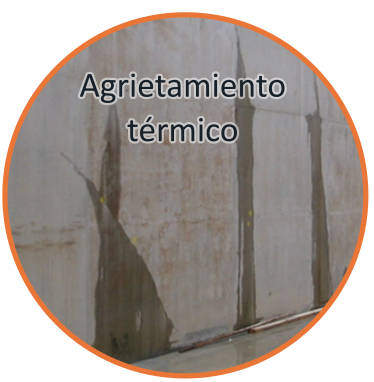
In large concrete elements (mine foundations, dams, bridge piers, wind-turbine foundations, port structures) the heat released while cement hydrates builds up inside the mass. In the first hours and days, while the concrete is still weak, the resulting temperature differences create internal stresses that can crack it. Early-age cracking means costly repairs, reduced durability and lower structural performance.
Chile is in the middle of a concrete-intensive infrastructure cycle in mining, water, roads, energy and ports, and standards increasingly ask for performance-based, traceable temperature and cracking control. Current practice still relies mostly on prescriptive limits on temperatures or gradients.
The project
The project develops a science-based system to predict, mitigate and document early-age cracking in mass concrete:
- Coupled thermo-mechanical simulation, calibrated with Chilean concretes and fed with field data such as heat-of-hydration curves measured on site;
- Monitoring of temperatures and environmental conditions during curing, to update cracking risk as the pour progresses;
- Actionable recommendations for placing temperature and sequence, insulation, and pre-cooling or active cooling;
- Traceability, producing verifiable records for quality control.
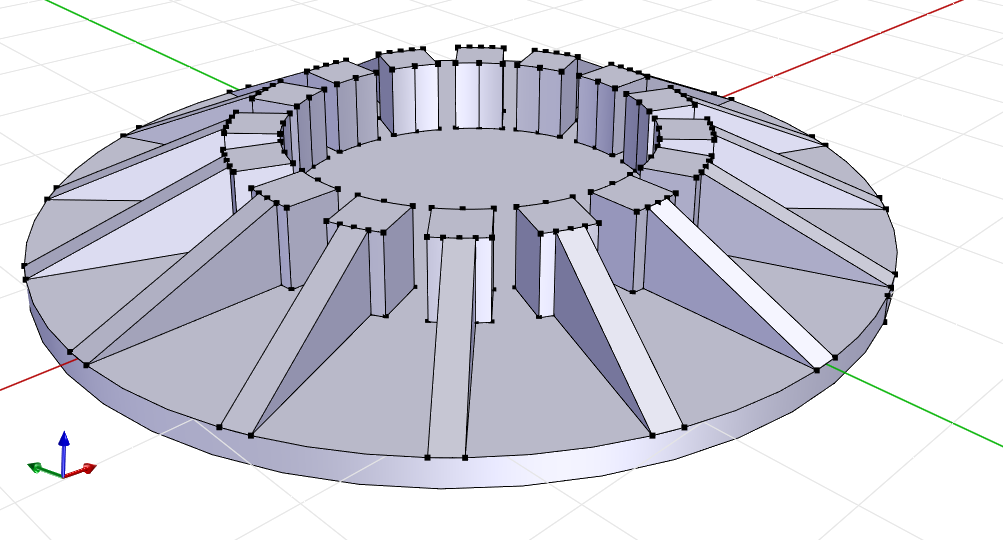
Numerical model of a mass concrete foundation, a typical element at risk of early-age thermal cracking.
The project builds on a line of work at Universidad de los Andes since 2019: thermal models validated against instrumented concrete blocks, low-cost semi-adiabatic calorimeters, and a coupled thermo-mechanical constitutive formulation implemented in OpenSees (see the master's theses on the People page). The goal is to take this technology to a laboratory-validated prototype.
Join the project
We're looking for PhD students and postdoctoral researchers interested in concrete materials and structures with a computational and experimental mix. Useful backgrounds (no one needs all of them):
- thermo-mechanics of concrete, early-age behavior, cracking and damage models;
- finite-element modeling (OpenSees experience is a plus);
- experimental work: instrumentation, sensors, calorimetry;
- software and data: Python, data pipelines, sensor and IoT systems.
The work combines simulation, laboratory testing and collaboration with industry partners.
PhD candidates can be Chilean or international and would enroll in the doctoral program at Universidad de los Andes. This PhD opportunity requires being awarded an ANID doctoral scholarship. Postdoctoral candidates must be Chilean nationals under the applicable ANID provisions. I can discuss project fit and support the relevant applications; scholarship awards are competitive. Read the full opportunity and application guidance, or email jaabell@uandes.cl with a short CV and a few lines on your interests.