One beam.
Three solvers.
OpenSeesMP
Structural simulation with Tcl commands. This run uses the Ladruño build.
Kratos
Multiphysics framework. Structural Mechanics and Trilinos handle the distributed solve.
FEniCSx
Variational forms define the model. DOLFINx assembles it and PETSc provides the solver.
Same quadratic tetrahedra · Same J2 steel model · MUMPS for the CPU benchmark
Esmeralda compute cluster
node12Ryzen 9 5950X
16 cores · 62.7 GiB RAM
25 GbERoCE / TCP
node13Ryzen 9 5950X
16 cores · 62.7 GiB RAM
gpu01RTX 5090
Ryzen 9 9950X · 32 GB VRAM
4 / 8 / 16 ranks on node1332 ranks on node12 + node13Slurm 24.11.5 · Debian 13 · shared NVMe-backed NFS
A cantilever under gravity
Fixed at x = 0 · arrows show distributed body forceLoading the model…
250 MPa yield · 210 GPa Young’s modulus · Small-strain J2 perfect plasticity
Same geometry. Two meshes.
Coarse 7,140 T10 elements
Fine 69,600 T10 elements
One exterior face of a T10 3 corner nodes 3 midside nodes
Gmsh ten-node tetrahedra · Exterior faces
Split the beam. Share the solve.
Coarse 4 MPI ranks
Fine 16 MPI ranks
One color per MPI rank. Opening the domains reveals the actual shared interfaces.
Where the beam yields
Model axes · +X clamp to tip · +Z up · +Y right in End view
A
CLAMP → FREE ENDLoading run A…
B
CLAMP → FREE ENDLoading run B…
3D requires WebGL 2. The plot, timing tables and sample field image are available below.
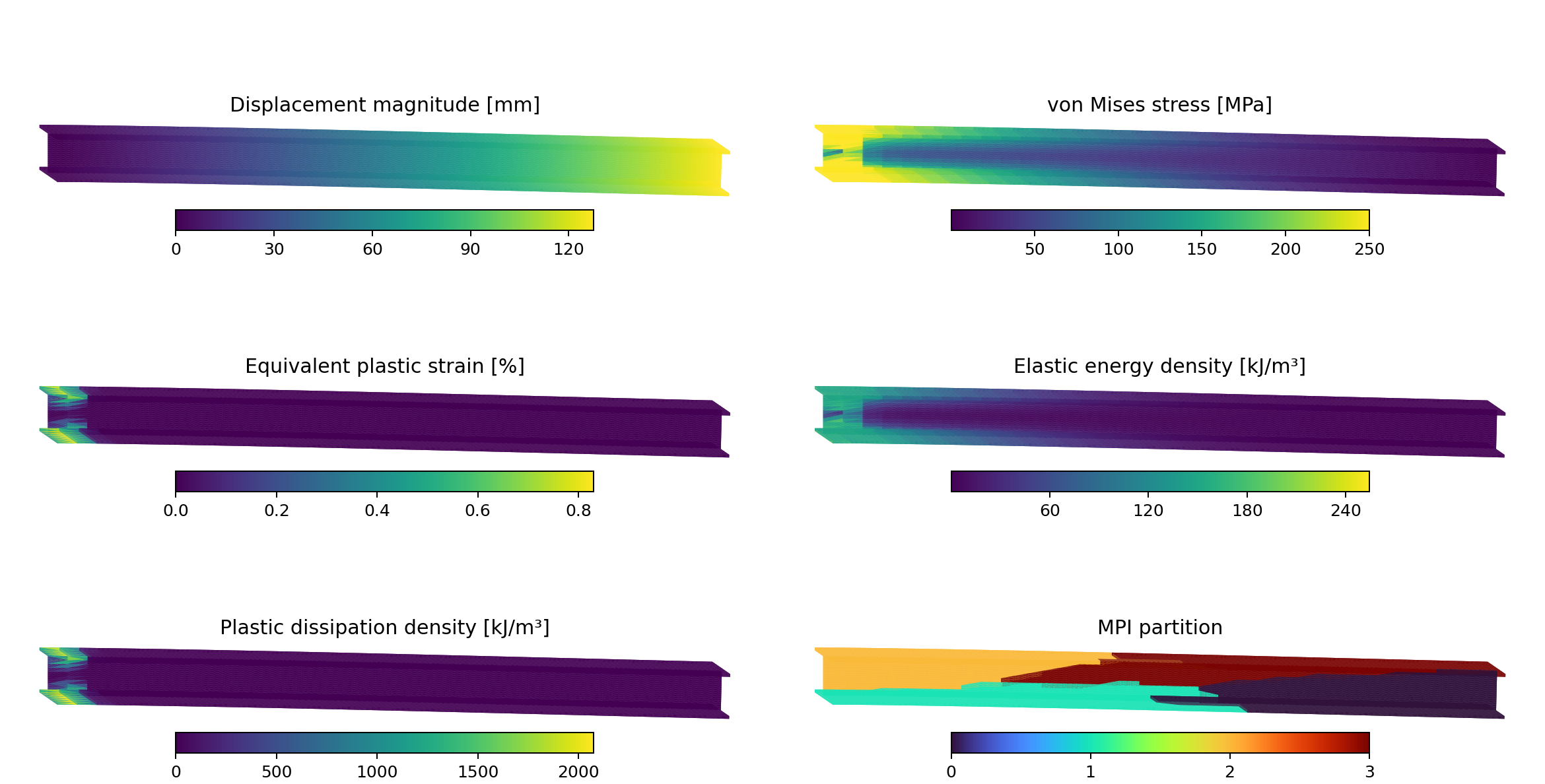
Cell colors show four-point means on the T10 surfaces. Shear strain is shown as tensor strain εij.
Force vs. displacement
Load response
How each solver handles the equations
Assemble tangent K and residual r
⇢
Linear SOE K Δu = −r
⇢
Update u ← u + Δu
One MPI rank. One GPU.
CPU · FEniCSxAssemble
Form the sparse tangent and residual for each Newton iteration.
⇢
RTX 5090 · JAX / CUDASolve in FP64
A persistent JAX worker copies the CSR matrix and right-hand side to the device, then solves for the increment.
⇢
CPU · FEniCSxUpdate
Bring the increment back. Update displacement, test convergence and write fields.
K Δu = −rOne CPU core runs the host rank that owns the whole model.
GPU benchmark results
Three repeats per backend · Same host and single MPI rank · Median wall time
29 pmLargest CPU–GPU tip difference3.1–16.2×GPU / CPU wall time in these pilots
Sparse QR ran out of memory on the fine mesh. The fine elastic pilot used Jacobi-preconditioned conjugate gradients.
What the benchmark shows
+8.6%Mesh sensitivity
Fine-mesh tip displacement at 29× gravity, compared with the coarse mesh.
8 / 16 ranksFine mesh on node13
Kratos had its lowest median at 8 ranks. OpenSeesMP and FEniCSx had theirs at 16.
3 of 3CPU MUMPS wins
CPU MUMPS took less wall time in each single-rank GPU pilot.
191.98 kN is the pure-bending reference. The 3D collapse load remains undetermined.

 Esmeralda / Finite element benchmark