Publications
Earthquake engineering, computational mechanics, geotechnics, open-source simulation, and how we teach the next generation of engineers.
 2026 · Engineering StructuresDynamic amplification of isolated shear wallsWhat controls the seismic shear amplification in reinforced-concrete walls?
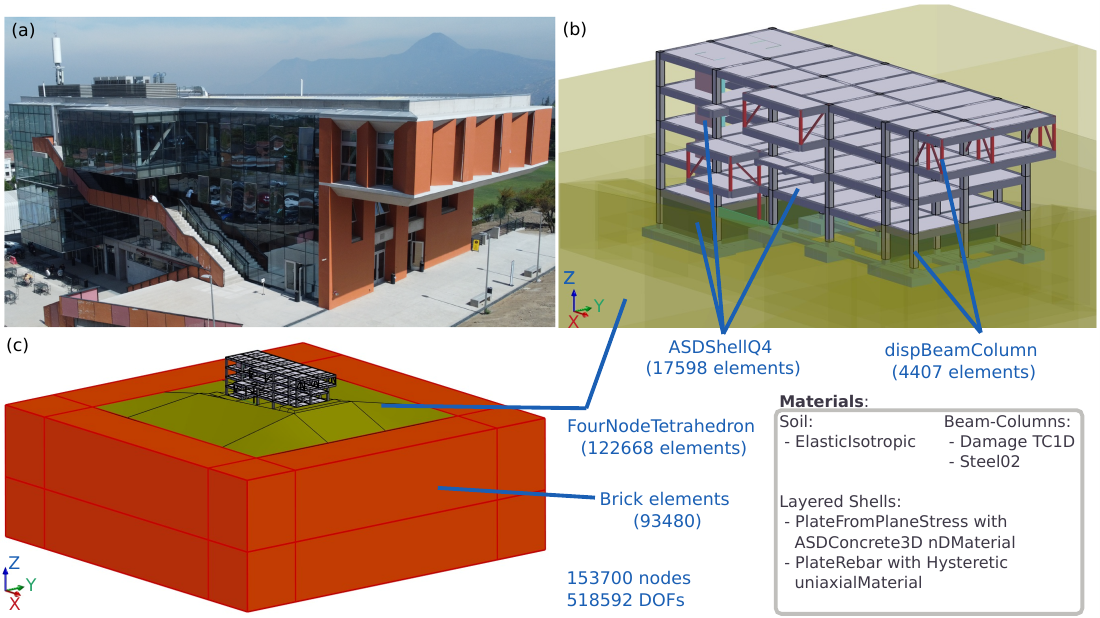 2025 · Earthquake Engineering & Structural DynamicsHow much do SSI modeling choices change a building's predicted response?Comparing detailed wave-field, plane-wave, and fixed-base simulations.
Journal articles
Select a paper to read its overview and follow the publication link.
2026
Engineering Structures · 2026 Dynamic amplification of isolated shear walls: Insights from layered shell modeling 358, 122641 · DOI: 10.1016/j.engstruct.2026.122641
This study investigates the dynamic shear amplification factors in reinforced concrete wall systems subjected to seismic ground motions. After validating a modeling strategy for shear walls using layered shell elements, a comprehensive parametric analysis was performed using approximately 1460 numerical models, of which 343 satisfied convergence and capacity criteria and were retained for evaluation. Analysis of walls ranging from 35 to 105 m in height with web transverse reinforcement from 0.25% to 1.40% revealed dynamic shear amplification factors between 1.0 and 2.75. Maximum amplification occurred in taller walls under low axial load ratio (0.10 fc′Ag), while high axial load ratios (0.30 fc′Ag) reduced peak amplification to approximately 1.5. Statistical analysis identified the normalized position of the resultant lateral force as the most accurate predictor of dynamic amplification. A regression model based on the normalized force resultant position was developed and validated through normality tests of residuals, demonstrating robust agreement with observed data. Mean amplification trends showed reasonable agreement with ACI 318-25 formulations, though substantial scatter indicates that the effective position of the force resultant is essential for accurate prediction beyond the number of stories alone.
2025
Earthquake Engineering & Structural Dynamics · 2025 Impact of Soil–Structure Interaction Modeling Simplifications and Structural Nonlinearity on Uncertainty in EDPs: A Case Study on an Existing RC Building in Santiago 54(8), 2062–2083 · DOI: 10.1002/eqe.4340
This study investigates the impact of modeling simplifications on the uncertainty of seismic response in numerical simulations, focusing on a five-story, asymmetric-plan, reinforced-concrete building in Santiago, Chile, subjected to simulated seismic motions from hypothetical events at the San Ramón fault (SRF). A comparative analysis is conducted between a high-complexity reference model and lower-complexity models. The reference model incorporates three-dimensional seismic inputs using the domain reduction method (DRM) and a detailed structural model accounting for material nonlinear behavior. The complexity of the models is systematically reduced to assess the effects of different soil–structure interaction (SSI) modeling assumptions, including DRM and plane-wave (PW) input and fixed-base (FB) conditions. For each model, both linear and nonlinear material behaviors are considered. Given the lack of historical records from the SRF, the study employs source-to-structure physical simulation. Simulations are conducted in OpenSees using input motions from 10 realizations of a Mw = 6.7 event at the SRF, generated with the ShakerMaker Python library. With respect to the reference model, PW assumptions moderately increase uncertainty across different engineering demand parameters (EDPs) and analysis directions. Conversely, FB conditions significantly elevate modeling uncertainty, drastically changing the mean and variance of computed EDPs. A simple EDP sensitivity score is proposed to compare the statistics of computed EDPs and rank models with respect to the reference model. Linear FB models may outperform nonlinear FB models, highlighting a complex relationship between structural nonlinearity and soil flexibility modeling. High-complexity modeling accounting for the spatiotemporal complexity of the seismic wave field may be needed for response quantities sensitive to high frequencies. Even for this building, located on very stiff soil, SSI effects cannot be neglected because they can produce unpredictable changes in the mean and variance of computed EDPs.
2024
Computer Applications in Engineering Education · 2024 Integrating advanced computational skills into engineering education: A discipline-based approach 32(6), e22784 · DOI: 10.1002/cae.22784
In an era where technology continually reshapes the landscape of professional practice, it has become relevant to equip engineering students with advanced computational skills beyond programming. This article presents a novel discipline-based framework designed to integrate advanced computational skills into engineering education. Responding to challenges such as the disconnection between computational abilities and domain-specific knowledge, and student demotivation due to overwhelming technological challenges, this study aims to validate the impact of the framework on domain learning, computational skill acquisition, and perceived future utility. Implementing a case study approach, we explore the development of high-performance computing skills within a project-based learning context in Civil Engineering. Results indicate significant improvements in students' understanding of both computational concepts and the engineering domain, evidenced by enhanced self-perception and positive Technology Acceptance Model outcomes. The framework facilitated a meaningful connection between computational skills and professional applications, as seen in students' project reflections. Despite the promising results, the necessity for instructors to possess and impart computational knowledge is highlighted as an important factor for successful integration. This study contributes to educational computing research by providing a scalable approach to embedding advanced computational skills in engineering curricula, addressing existing educational challenges, and suggesting directions for future research.
Advances in Engineering Software · 2024 Domain specific language for finite element modeling and simulation 193, 103666 · DOI: 10.1016/j.advengsoft.2024.103666
This paper introduces the Finite Element Interpreter (FEI), a domain-specific language for linear and nonlinear finite-element analysis of soils and structures. Its self-documenting scripts make physical units and modeling choices explicit, with examples ranging from small test problems to Real-ESSI simulations.
2023
Soil Dynamics and Earthquake Engineering · 2023 How do tall buildings affect seismic earth pressures on their basement walls? 171, 107968 · DOI: 10.1016/j.soildyn.2023.107968
Construction of tall buildings has recently gone through an exponential growth in major cities, creating new challenges in earthquake engineering and design. For instance, existing analytical procedures for evaluating seismic lateral earth pressures on basement walls that are connected to these buildings typically ignore the inertia and dynamic properties of the superstructure. The inertial forces from a tall superstructure may cause additional displacements and rotations in its basement that would affect the distribution and magnitude of seismic lateral earth pressures. These additional soil- basement-structure interaction (SBSI) effects are currently not well understood. Hence, the applicability and reliability of existing procedures to the basements of tall buildings remains questionable. In this paper, we use an experimental-numerical approach to provide insight on how the lateral resisting system of tall superstructures may impact the magnitude and distribution of seismic earth pressures on basement walls buried in dry sand and gravel. Numerical simulations are first validated in 3D using a prior centrifuge experiment that included a simplified model of a 42-story, highrise structure in medium-dense, dry sand. Then, the numerical tool is used to perform 156, 2D, nonlinear simulations of more realistic buildings and basements, ground motion characteristics, as well as both sandy and gravely soil profiles. Nonlinear numerical simulations are shown to successfully capture the building’s inertial and kinematic seismic interactions with the basement and an adjacent underground structure. The subsequent numerical sensitivity study showed that inertial forces from a tall superstructure increase total lateral earth pressures on the basement walls. This increase is particularly notable in the top two-thirds of the basement wall and can be approximated by a trapezoidal distribution. The superstructure’s inertia amplifies the seismic earth pressure increments at shallow depths, with an approximately inverted triangular shape. These effects and reliability of existing analytical procedures are shown to be highly sensitive to the building’s modal frequencies in relation to the frequency content of the input motion as well as the stiffness of the structure-basement system in relation to the underlying soil. The results point to the importance of considering the building’s dynamic properties and inertia in evaluation of seismic earth pressures on basement walls, in order to avoid unsafe estimations or the need for overdesign.
2022
Computers and Geotechnics · 2022 Probabilistic characterization of a high-cycle accumulation model for sands 147, 104798 · DOI: 10.1016/j.compgeo.2022.104798
In this paper, we employ a Bayesian approach to estimate the parameters of a high cycle accumulation model for sands using experimental data. Global sensitivity analysis and Markov-Chain Monte Carlo simulation are conducted for each of the twenty-four available experimental drained triaxial test results, considering the effect of estimating soil parameters at each strain-cycle under several loading conditions. Probability distributions inferred from each data source are then combined to obtain a single distribution for model parameters. Model calibration is then validated against new observations. The accumulated strain model is calibrated through explicit computation of strain at each cycle and the strain dependence of model parameters is included through the cyclic variation of the model constants.
Engineering Structures · 2022 Soil–basement interaction effects on the seismic response of tall buildings with basement levels 263, 114406 · DOI: 10.1016/j.engstruct.2022.114406
The need to build tall buildings has been increasing worldwide, creating new challenges in earthquake engineering and design. Many of the current analysis methods cannot be extrapolated beyond the definition under which they were established. Prior studies and existing seismic design guidelines have indicated that the current fixed-base hypothesis for evaluating the seismic response of structures is not sufficient to properly represent the boundary conditions and behavior of tall buildings with basement levels. Studies of soil-structure interaction (SSI) for tall buildings have, however, typically been inconclusive. It is not clear under which conditions consideration of soil-basement-structure interaction (SBSI) is necessary for the design of the superstructure, foundation, and basement levels and when it can safely be avoided. Given the rising demand, it is essential to evaluate the relation of global system variables such as the basement depth, structure height, and soil characteristics with the building's response via numerical and experimental modeling. Therefore, an experimental-numerical approach is presented to better understand the seismic response of tall buildings with basement levels, considering explicit SBSI modeling. Chilean tall buildings and soil conditions are used as study cases, analyzed using non-linear finite element analyses in conjunction with results from centrifuge experiments. The results show how seismic response parameters and modals characteristics, such as inter-story drifts, shear force, bending moment, natural frequencies and damping ratios, change when SBSI is appropriately incorporated. The results point to the importance of considering soil-basement-interaction effects to evaluate the seismic response of tall buildings with basement levels and avoid unsafe estimations or the need for overdesign.
SoftwareX · 2022 ShakerMaker: A framework that simplifies the simulation of seismic ground-motions 17, 100911 · DOI: 10.1016/j.softx.2021.100911
ShakerMaker is an open-source python framework which simplifies the
generation of synthetic broad-band seismograms, produced by finite-fault
kinematic representations of earthquake ruptures, using a 1-D layered model
of the crust and the frequency-wavenumber ($f$–$k$) method. It is designed to
bring closer the engineering seismology and earthquake engineering communi-
ties, by catering to the earthquake simulation needs of both disciplines. One
particular goal of this framework is to provide a simple way to produce high-
fidelity earthquake motions for use with the domain-reduction method, sim-
plifying the setup of physically accurate finite-element simulations of multi-
scale seismological and earthquake engineering problems through the use of
a new specialized file format.
ShakerMaker’s core is composed of a high-performance Fortran imple-
mentation of the $f$-$k$ method, that is exposed to the user as a python frame-
work. Its software architecture emphasizes simplicity, extensibility, and per-
formance, allowing users to specify complex simulation scenarios with short
scripts. The message passing interface is used to achieve scalability from
simple single-processor machines to HPC clusters.
Géotechnique · 2022 From cyclic sand ratcheting to tilt accumulation of offshore monopiles: 3D FE modelling using SANISAND-MS 72(9), 753–768 · DOI: 10.1680/jgeot.20.p.029
Serviceability criteria for offshore monopiles include the estimation of long-term, permanent tilt under repeated operational loads. In the lack of well-established analysis methods, experimental and numerical research has been carried out in the last decade to support the fundamental understanding of monopile-soil interaction mechanisms, and the conception of engineering methods for monopile tilt predictions. With focus on the case of monopiles in sand, this work shows how step-by-step/implicit, three-dimensional finite element modelling can be fruitfully applied to the analysis of cyclic monopile-soil interaction and related soil deformation mechanisms. To achieve adequate simulation of cyclic sand ratcheting and densification around the pile, the SANISAND-MS model recently proposed by Liu et al. (2019) is adopted. The link between local soil behaviour and global monopile response to cyclic loading is discussed through detailed analysis of model prediction. Overall, the results of numerical parametric studies confirm that the proposed 3D FE modelling framework can reproduce relevant experimental evidence about monopile-soil interaction, and support future improvement of engineering design methods.
2021
Journal of Earthquake Engineering · 2021 online Modeling the loss of vibration energy in buildings to elastic-waves using high-fidelity FE modeling and absorbent exterior boundaries DOI: 10.1080/13632469.2021.1927904
The modeling of structural damping due to the excitation of elastic-waves into the surrounding soil domain, and its effect on structural response as apparent modal damping is explored herein. Four high-fidelity, linear finite-element mod- els of building-site systems, with 20 to 50 storeys and 2 to 7 basement levels, are simulated in OpenSees to evaluate their frequency response. Radiation-damping is provided by a layer of high-damping elements, which design is explored in detail. Results show that up to 1% of apparent, low-amplitude damping can be attributed to radiation-damping depending on number of stories and depth of embedment.
Computer Methods in Applied Mechanics and Engineering · 2021 Extending the Particle Finite Element Method for sediment transport simulation 380, 113772 · DOI: 10.1016/j.cma.2021.113772
The present work extends the capabilities of the Particle Finite Element Method (PFEM), which allows modeling of soil-fluid-structure interaction problems, to allow the modeling of sediment transport and scouring effects. This is accomplished by implementing scouring rules on an evolving scourable-interface, i.e. the interface surface between fluid and soil. The proposed method improves upon previous proposals by jointly capturing both the temporal and spatial scales of scouring evolution, as shown in the presented validation exercise, and also because its parametrization is conforms with commonplace engineering procedures for scouring prediction. The extension preserves desirable PFEM properties such as conservation of mass, mesh-size independence, and stability of the numerical solution of the PFEM equations.
2020
Journal of Geotechnical and Geoenvironmental Engineering · 2020 Memory-Enhanced Plasticity Modeling of Sand Behavior under Undrained Cyclic Loading 146(11) · DOI: 10.1061/(ASCE)GT.1943-5606.0002362
This work presents a critical state plasticity model for predicting the response of sands to cyclic loading. The well-known bounding surface SANISAND framework by Dafalias & Manzari (2004) is enhanced with a `memory surface' to capture micro-mechanical, fabric-related processes directly effecting cyclic sand behaviour. The resulting model, SANISAND-MS, was recently proposed by Liu et al. (2019) , and successfully applied to the simulation of drained sand ratcheting under thousands of loading cycles. Herein, novel ingredients are embedded into Liu et al. (2019) 's formulation to better capture the effects of fabric evolution history on sand stiffness and dilatancy. The new features enable remarkable accuracy in simulating undrained pore pressure build-up and cyclic mobility behaviour in medium-dense/dense sand. The performance of the upgraded SANISAND-MS is validated against experimental test results from the literature - including undrained cyclic triaxial tests at varying cyclic loading conditions and pre-cyclic consolidation histories. The proposed modelling platform will positively impact the study of relevant cyclic/dynamic problems, for instance, in the fields of earthquake and offshore geotechnics.
Environmental Science & Technology · 2020 Mechanistic Description of Convective Gas–Liquid Mass Transfer in Biotrickling Filters Using CFD Modeling 54(1), 419–426 · DOI: 10.1021/acs.est.9b02662
The gas−liquid mass transfer coefficient is a key parameter to the design and operation of biotrickling filters that governs the transport rate of contaminants and oxygen from the gas phase to the liquid phase, where pollutant biodegradation occurs. Mass transfer coefficients are typically estimated via experimental procedures to produce empirical correlations, which are only valid for the bioreactor configuration and range of operational conditions under investigation. In this work, a new method for the estimation of the gas−liquid mass transfer coefficient in biotrickling filters is presented. This novel methodology couples a realistic description of the packing media (polyurethane foam without a biofilm) obtained using microtomography with computational fluid dynamics. The two-dimensional analysis reported in this study allowed capturing the mechanisms of the complex processes involved in the creeping porous air and water flow in the presence of capillary effects in biotrickling filters. Model predictions matched the experimental mass transfer coefficients (±30%) under a wide range of operational conditions.
2019
Géotechnique · 2019 Modelling the cyclic ratcheting of sands through memory-enhanced bounding surface plasticity 69(9), 783–800 · DOI: 10.1680/jgeot.17.P.307
The modelling and simulation of cyclic sand ratcheting is tackled via a plasticity model formulated within the critical-state, bounding-surface SANISAND framework. For this purpose, a third locus—termed the “memory surface”—is cast into the constitutive formulation to capture fabric-related processes relevant to cyclic response. The predictive capability of the model under numerous loading cycles is explored under drained loading conditions and validated against triaxial, simple-shear, and oedometer test results. The model reproduces the transition from ratcheting to shakedown with a single set of soil parameters across different initial, boundary, and loading conditions. This work contributes to the analysis of soil–structure interaction under high-cyclic loading events, such as those induced by environmental or traffic loads.
2018
Earthquake Engineering & Structural Dynamics · 2018 Earthquake soil–structure interaction of nuclear power plants, differences in response to 3-D, 3 × 1-D, and 1-D excitations 47(6), 1478–1495 · DOI: 10.1002/eqe.3026
In soil-structure interaction modeling of systems subjected to earthquake motions, it is classically assumed that the incoming wave field, produced by an earthquake, is unidimensional and vertically propagating. This work explores the validity of this assumption by performing earthquake soil-structure interaction modeling, including explicit modeling of sources, seismic wave propagation, site, and structure. The domain reduction method is used to couple seismic (near-field) simulations with local soil-structure interaction response. The response of a generic nuclear power plant model computed using full earthquake soil-structure interaction simulations is compared with the current state-of-the-art method of deconvolving in depth the (simulated) free-field motions, recorded at the site of interest, and assuming that the earthquake wave field is spatially unidimensional. Results show that the 1-D wave-field assumption does not hold in general. It is shown that the way in which full 3-D analysis results differ from those which assume a 1-D wave field is dependent on fault-to-site geometry and motion frequency content. It is argued that this is especially important for certain classes of soil-structure systems of which nuclear power plants subjected to near-field earthquakes are an example.
2014
Bulletin of the Seismological Society of America · 2014 Synthetic Hybrid Broadband Seismograms Based on InSAR Coseismic Displacements 104(6), 2735–2754 · DOI: 10.1785/0120130293
Conventional acceleration records do not properly account for the observed coseismic ground displacements, thus leading to an inaccurate definition of the seismic demand needed for the design of flexible (long-period) structures. Large coseismic displacements observed during the Feb 27, 2010, Maule earthquake, suggest that this effect should be included in the design of flexible structures by modifying the design ground-motions and spectra considered. Consequently, Green’s Functions are used herein to compute synthetic low-frequency seismograms that are consistent with the coseismic displacement field obtained from interferometry using synthetic aperture radar images. In this case, the coseismic displacement field was determined by interfering twenty SAR images of the ALOS-PALSAR satellite taken between 10/12/2007 and 05/28/2010. These images cover the region affected by the M w 8.8 2010, Maule earthquake. Synthetic broadband seismograms are built by superimposing the low-pass filtered synthetic low-frequency seismograms with high-frequency strong-motion data. The broadband seismograms generated are then consistent with the coseismic displacement field and the high-frequency content of the earthquake. A sensitivity analysis is performed using three different fault and slip parameters, the rupture velocity, the corner frequency, and the slip rise time. Results show that the optimal corner frequency of the low-pass filter $f_c = 1/T_c$ , leads to a trade-off between acceleration and displacement accuracy. Furthermore, spectral response for long periods, say $T \ge 8s$, is relatively insensitive to the value of $T_c$ , while shorter periods are strongly dependent on both, the slip rise time and $T_c$ . In general, larger displacements consistent with coseismic data are obtained using this technique instead of digitally processing the acceleration ground-motion records.
2011
Soil Dynamics and Earthquake Engineering · 2011 Enhancement of long period components of recorded and synthetic ground motions using InSAR 31(5), 817–829 · DOI: 10.1016/j.soildyn.2011.01.005
Tall buildings and flexible structures require a better characterization of long period ground motion spectra than the one provided by current seismic building codes. Motivated by that, a methodology is proposed and tested to improve recorded and synthetic ground motions which are consistent with the observed co-seismic displacement field obtained from interferometric synthetic aperture radar (InSAR) analysis of image data for the Tocopilla 2007 earthquake ($M_w=7.7$) in Northern Chile. A methodology is proposed to correct the observed motions such that, after double integration, they are coherent with the local value of the residual displacement. Synthetic records are generated by using a stochastic finite-fault model coupled with a long period pulse to capture the long period fling effect.It is observed that the proposed co-seismic correction yields records with more accurate long-period spectral components as compared with regular correction schemes such as acausal filtering. These signals provide an estimate for the velocity and displacement spectra, which are essential for tall-building design. Furthermore, hints are provided as to the shape of long-period spectra for seismic zones prone to large co-seismic displacements such as the Nazca-South American zone.
Conference papers
A. Hurtado, T. Vergara, E. Torres, J. A. Abell · World Conference on Earthquake Engineering, 2024.
Yuan Feng, José Abell, Sumeet Kumar Sinha, Han Yang, Fatemah Behbehani, Hexian Wang, Nebojša Orbović, David B. McCallen, Boris Jeremić · SMiRT 24, Busan, 2017.
J. A. Abell, J. G. F. Crempien, Boris Jeremić · 16th World Conference on Earthquake Engineering, 2017.
José Antonio Abell Mena, Sumeet Kumar Sinha, Boris Jeremić · IAEA conference on physics-based fault rupture models for seismic hazard assessment of nuclear installations, Vienna, 2015.
Nebojša Orbović, Boris Jeremić, José Antonio Abell Mena, Chao Luo, Robert P. Kennedy, Andrei Blaihoanu · SMiRT 2015, Manchester.
N. Tafazzoli, F. Pisanò, J. A. Abell M., B. Kamrani, C.-G. Jeong, B. Aldridge, R. Roche, A. Kammerer, Boris Jeremić · SMiRT 22, San Francisco, 2013.
Theses
Ph.D. dissertation · University of California, Davis · 2016.
Master's thesis · Pontificia Universidad Católica de Chile · 2009.
Research manuscripts
Marco Herrera, Jorge G. F. Crempien, Roberto Benavente, José A. Abell · Manuscript.